Transform strategic visions into measurable results by connecting boardroom plans to frontline actions and financial outcomes, bridging the execution gap

The Deck That Nobody Reads
Somewhere on your company’s server sits a 50-slide deck. It’s your strategy—beautifully designed, packed with market analysis, and brimming with ambitious R&D roadmaps. But for all its polish, it’s a museum artifact. It has no pulse. It doesn’t breathe in your engineering sprints or on your factory floor because it isn’t connected to the two things that actually drive your business: tactical action and financial reality.
The problem isn’t a lack of ideas. It’s a failure of translation. We fail to convert strategic “words” into financial “value” and operational “work.” This isn’t conjecture—it’s documented across industries. The chasm between the boardroom and the front line is where value dies. Globally, organizations waste approximately $1 million every 20 seconds due to ineffective strategy implementation, totaling a staggering $2 trillion annually.
This disconnect reveals a crisis of confidence and communication. While 80% of leaders believe their company excels at crafting strategy, only 44% think they’re effective at implementation. This gap is so severe that a mere 2% of leaders are confident they’ll achieve 80-100% of their strategic objectives.
The most damning evidence? Up to 95% of employees don’t understand or aren’t even aware of their company’s strategy.
Closing this strategy-to-execution gap isn’t about vague cultural transformation. It requires achieving two specific, non-negotiable outcomes:
- Every team member knows what to deliver (the strategy) and how to deliver it (through projects)
- Every strategic initiative can be justified and measured in dollar terms
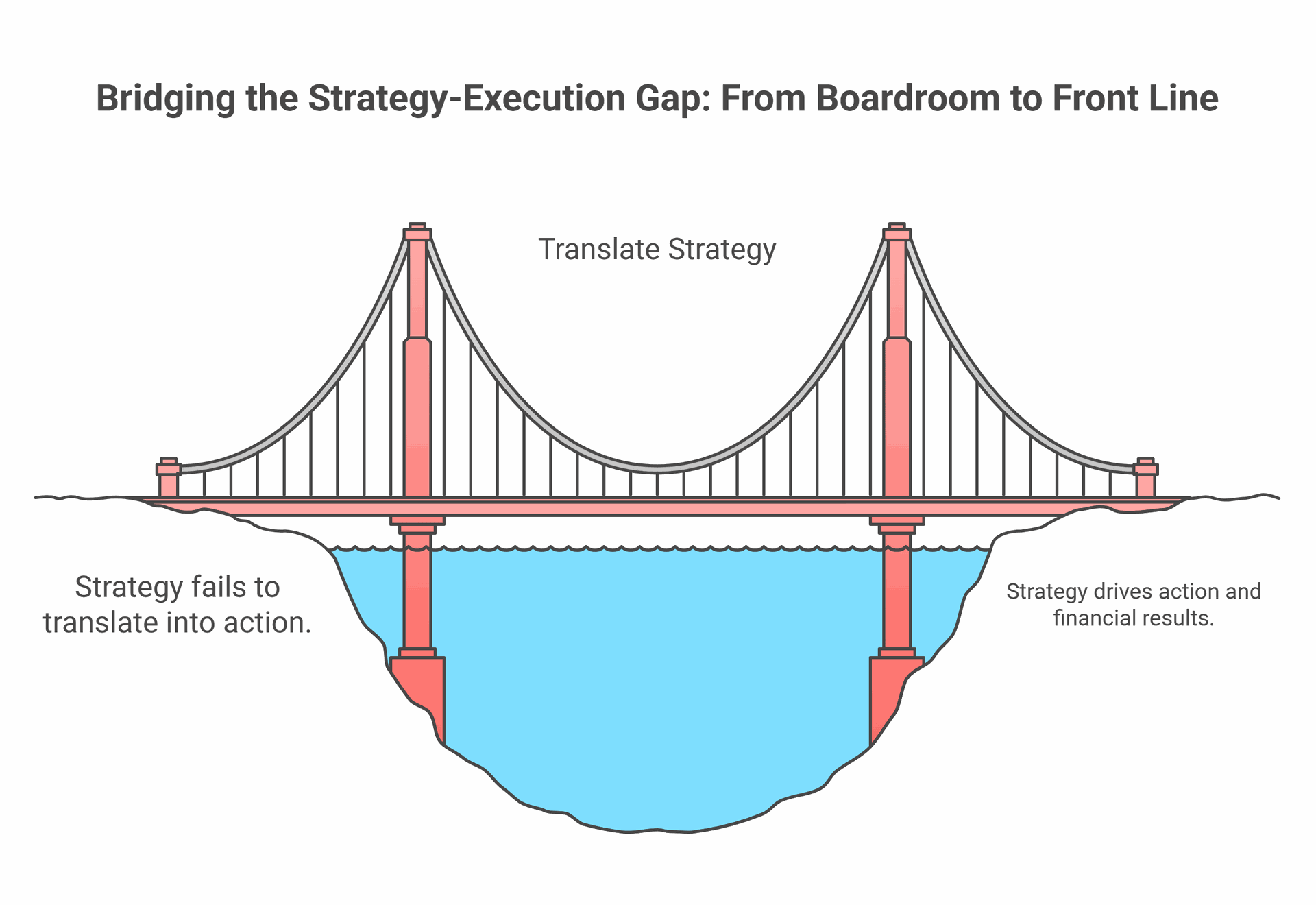
The Financial Anchor: Turning Words into Dollars
A strategy without financial grounding is just a collection of expensive wishes. Before building any plan, attach a price tag to every ambition. This crucial translation step transforms vague goals into concrete business objectives, forcing clarity and ruthless prioritization.
The method: create a “Value Hypothesis” for every major initiative, formalized in a business case with standard financial metrics like Net Present Value (NPV) and Internal Rate of Return (IRR).
Example 1 :
- Instead of this: “We will use more advanced materials in our new product line.”
- Say this: “By re-engineering our product’s chassis with a new composite material (the how), we will reduce Bill of Materials cost by 8% per unit (the what), saving $1.2M in Cost of Goods Sold at current production volume (the value).”
Example 2 :
- Instead of this: “Launch a next-generation product.”
- Say this: “By developing and launching ‘Project Titan’ with 20% increased battery efficiency (the how), we will capture 15% of the premium portable electronics market (the what), representing a $30M revenue opportunity in the first two years (the value).”
This financial rigor isn’t just for the CFO—it forces clarity across your entire product development cycle. If you cannot articulate an initiative’s value in dollar terms (whether in new revenue, cost savings, or market share), it shouldn’t command your precious engineering and manufacturing resources.
This discipline directly combats the 10-12% of investment that the Project Management Institute finds is wasted annually due to poor project performance.
Lifting the Strategy: From Financial Goals to Daily Work
The 50-slide deck is too heavy to lift. No wonder less than half of employees can clearly state their company’s strategy. If the people building your future don’t know the blueprint, you need a better system. You need to break strategy down and connect it to work happening in design labs and on assembly lines. This is how you “lift” strategy from paper to production.
Step 1: Use OKRs as the Translation Layer
Objectives and Key Results (OKRs) translate high-level, financially-anchored goals into a clear, measurable framework.
- Objective (The “What”): The ambitious, qualitative goal, like: “become the undisputed performance leader in the industrial drone market.”
- Key Results (The “How” + The ”$”): The measurable, financially-anchored outcomes that prove you have achieved the objective. These are not tasks; they are results.
Examples:
- KR1: Successfully launch the ‘Falcon V’ drone series by Q4, securing pre-orders valued at $5M.
- KR2: Reduce the unit production cost of the ‘Falcon V’ from an estimated $450 to $399 by optimizing the supply chain and assembly process.
- KR3: Decrease the warranty claim rate on new products from 3% to under 1.5%, avoiding $800,000 in replacement and service costs.
Step 2: Use Projects as the Engine
OKRs tell you the destination; projects are the vehicles that get you there. Every project must explicitly tie to moving a Key Result forward. This creates a “golden thread” from daily tasks to financial impact.
Examples:
- Project tied to KR1: “Falcon V Final Engineering Sprints & Prototyping.”
- Project tied to KR2: “Assembly Line Automation Initiative.”
- Project tied to KR3: “Component Stress-Testing & Enhanced QA Program.”
The success of the Assembly Line Automation project is no longer just “did we install the robots?” It is now measured by “did we hit the $399 unit cost target?”
Step 3: Avoid the Implementation Traps
The simplicity of OKRs is deceptive. Many implementations fail due to predictable pitfalls. Success requires discipline to avoid them.
- Lack of Alignment / Siloed Goals: Implement a top-down and bottom-up planning process. Leadership sets 3-5 strategic company OKRs, and teams then propose their own aligned OKRs.
- Key Results Written as Tasks: Enforce a strict definition: Key Results must measure outcomes, not outputs. They are results, not a to-do list.
- “Set It and Forget It” Mentality: Establish a non-negotiable rhythm of weekly or bi-weekly check-ins to discuss progress, roadblocks, and confidence levels.
The Human Element: Leadership as Accelerator
Frameworks provide structure, but they have no energy of their own. The lifeblood of execution is the human element—committed leadership and supportive culture. Astonishingly, 85% of leadership teams spend less than one hour monthly discussing strategy, with 50% spending no time at all. This disengagement is a primary cause of failure.
Leaders must shift from being strategy architects to becoming its most relentless champions. This means relentlessly communicating the “why” behind goals and empowering teams by removing roadblocks. Accountability isn’t about oversight—it’s about enabling success. When employees understand their roles and are empowered to shape their contributions, organizations don’t just execute better—they thrive.
The Leader’s Execution Checklist :
- Understand: Have I clearly and repeatedly articulated market dynamics and company strategy to my team? Do they understand why our goals matter?
- Translate: Does every team member have specific, measurable goals (e.g., OKRs) explicitly linked to the company’s strategic, financially-anchored objectives?
- Implement: Have I fought to ensure my team has necessary resources (budget, staffing, tools) to succeed? Have I clearly defined roles and responsibilities?
- Measure: Do we have a non-negotiable weekly or bi-weekly rhythm for reviewing progress? Are we tracking outcomes, not just activity?
- Adapt: Have I created a forum where the team can safely raise roadblocks and discuss failures as learning opportunities without fear of blame?
- Communicate: Am I consistently connecting daily work back to the bigger picture, making strategy an inescapable part of our conversation?
The Two-Question Alignment Test
How do you know if this is working? Apply this simple test to any initiative. True alignment exists only if you can answer “yes” to both questions.
If the answer to either question is “No” or “I’m not sure,” you don’t have alignment. You have potential waste.
Imagine reviewing a proposal to source a new, more expensive microprocessor for your flagship product.
Question 1: The Clarity Test (What & How)
Can the project lead articulate which strategic Objective this microprocessor serves and which specific Key Results its adoption will drive?
Example: “It will help us hit our KR for 20% increased performance, which is key to capturing the premium market.”
Question 2: The Value Test (The Dollars)
Can that same leader justify the increased cost by stating the expected financial return in dollar terms?
Example: “This $10 increase in BOM cost per unit will enable a $100 price premium, generating an additional $4.5M in margin at our forecast sales volume.”
Your Strategy as a Living P&L
Stop writing strategic novels. Start by anchoring every goal to a dollar value. Use OKRs to translate those financial goals into measurable outcomes. Power those OKRs with a portfolio of value-driven projects, championed by engaged leaders.
When you succeed, your strategy is no longer a document reviewed once yearly. It becomes a living, breathing part of your Profit & Loss statement, visible in daily decisions of your engineers, supply chain managers, and product teams. Your R&D roadmap doesn’t just lead to new features—it leads to predictable profit.
That is the ultimate form of execution.
Your First Step: pick one project on your product roadmap for the next quarter. Find its “value hypothesis.” If you can’t, don’t approve it until you can.